October 20, 2022
Experiential Learning
Students as VC Investors Online & In-person
Through a simulated VC process with pitches from real startups, students evaluate real companies and provide feedback on their business opportunities.
Read article




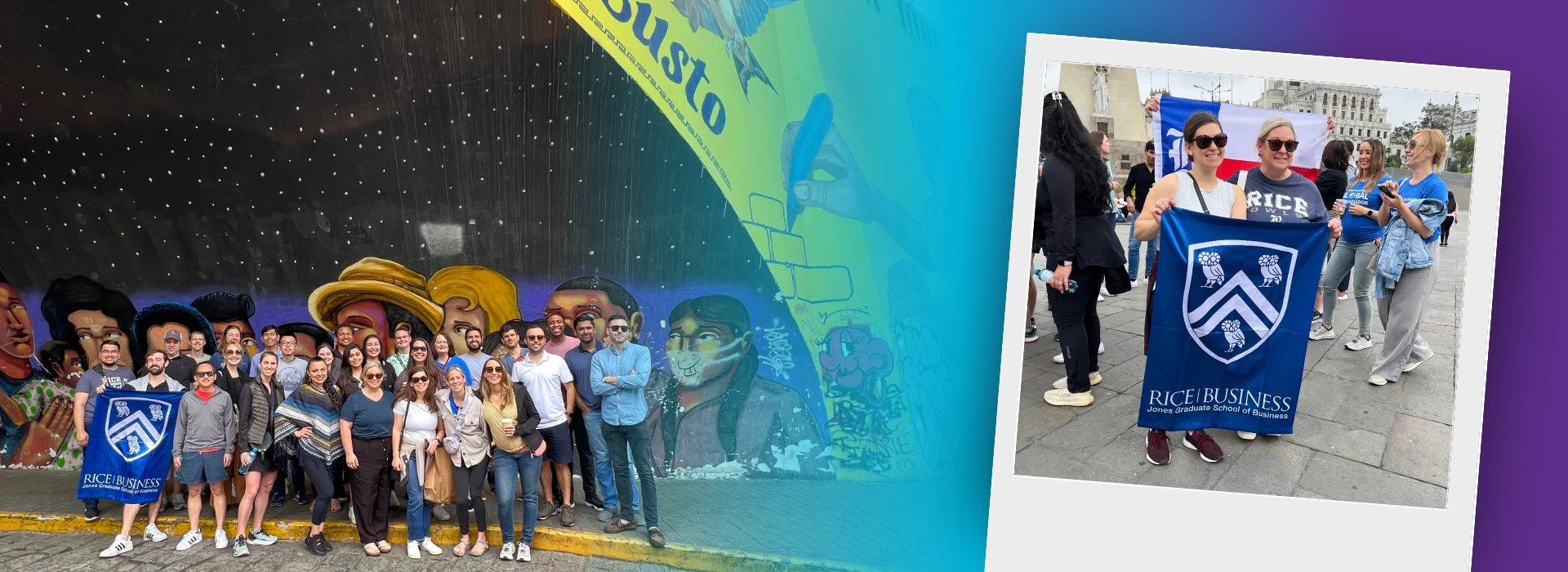
In today’s interconnected world, classroom boundaries no longer constrain learning. At Rice Business, their Global Field Experiences (GFEs) present an unparalleled opportunity for graduate students to apply theory to the complexities of international business.
Let’s dive into a rewarding partnership that has exemplified this educational evolution. We will explore our success case with Rice Business and how we have supported them in scaling their programs through the years. Rice has nurtured its program with international education elements that go beyond the conventional study abroad or study trips to deliver lasting value to students and the global business community. From its inception to its current form, we will spotlight the elements that have made it an impactful collaboration, scaling not just the number but the caliber of projects that drive home the essence of experiential learning.
Since our first program collaboration in Colombia in 2017, we have expanded across different countries, delivering 58 Global Field Experiences and consulting with hundreds of businesses. Over the past seven years, we have honed our best practices to ensure optimal experiences at every level, from project sourcing to on-the-ground program execution.
As part of Rice Business curriculum objectives, the focus of the GFE experience is in one specific type of international environment – the emerging market context, and there are top 3 reasons why:
Much of the coursework in the MBA program focused on concepts and frameworks that have been developed based on developed economies such as the USA. The underlying assumption of such framework and concepts is that there is no information asymmetry between participants in economic transactions. Specifically, economic institutions have been established in economies with little opportunity for information arbitrage.
In contrast, emerging markets have less developed institutions, leading to questions about how concepts and frameworks developed in the context of developed economies can be applied to emerging markets. Through the GFE, Rice business allows students to identify how economic institutions differ between such markets and examine the implications of such differences for firms and their strategies.
Understanding the emerging market context and the differences between the developed and emerging market contexts has increasingly become important. For instance, the top 6 economies in 1990 were the USA, Japan, Germany, the UK, France and Italy. Today, India and China are in the top 6 (China is number 2). In another 20 years, it is expected that apart from the USA and Japan, there will be no other developed economy on that list. China, India, Brazil, and Russia are expected to make the rest of the top 6. They would account for almost 40% of the world’s GDP. This suggests that most of your jobs and careers involve extensive interaction with these markets. In other words, even if you don’t plan on moving out of the USA, your life, job, and career will still be impacted by what happens in today’s emerging markets.
The Global Field Experience isn’t an elective — it’s a core curriculum component of the Rice Business learning machine. Here, the premise is simple but profound in its implications; students take their classroom learnings from the first year and immediately put them to the test in a real-world international setting, acutely discerning the socio-economic and cultural tremors that affect business operations daily.
The projects undertaken during these global field experiences extend a diverse spectrum. By shading the consulting experience with the kaleidoscope of international scenery, these MBAs have to decipher market intricacies that would be irreplicable domestically. The insights offered are organically nuanced, and the solutions are not one-size-fits-all but tailored: the epitome of strategic consulting.

The Rice-Austral relationship has become increasingly collaborative over the years as we have learned and innovated together to improve the GFE. The first consulting projects that we sourced for Rice in 2017-2018 were very different from the consulting projects we are sourcing for them today, and this is the result of some incredibly innovative curriculum design by Rice as well as Austral’s expertise in different markets and economies in Latin America, deciding which best serve Rice’s needs along with balancing risk and safety concerns and the ability of a location to offer a memorable and culturally relevant experience for the students. I think the key piece of our successful partnership with Rice is fluid and consistent communication, which has allowed us to develop deep, collaborative relationships between the Rice Global team and amongst our staff across many different departments, from our Operations team to Risk Management to Experiential Learning, to Finance. We all want to put together the best experience possible for the Rice students, and striving for excellence between all of us is what drives innovation.




.webp)

.webp)


.svg)